


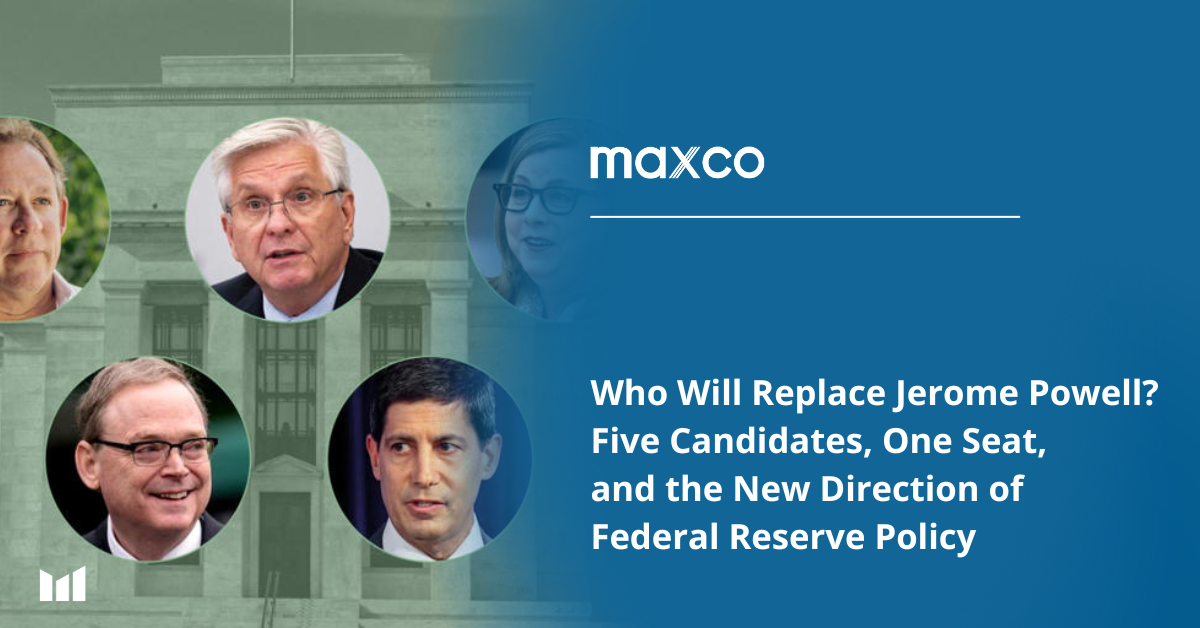
December 2025 could become one of the most critical moments for global markets in the past decade. U.S. President Donald J. Trump is expected to announce his nominee for the next Chair of the Federal Reserve before Christmas—well ahead of Jerome Powell’s term ending in May 2026.
This move is far more than a formality. It signals a potential shift in the direction of U.S. monetary policy—from years of tightening to a more aggressive low-interest-rate cycle.
With inflation gradually easing, economic growth slowing, and the labor market starting to weaken, the selection of the next Fed Chair will determine whether the U.S. enters a period of renewed monetary stimulus or maintains higher interest rates for longer to guard against a resurgence in inflation.
And the candidates offer sharply different visions.
The Candidate List: From White House Economists to Federal Reserve Governors
Five names have made the short list. They represent various institutions: government, the private sector, and the Federal Reserve System itself.
Candidates for Federal Reserve Chair
Federal Reserve Chair Candidates
| Candidate Name | Current / Previous Position | Policy Stance | Market Narrative | Winning Probability |
|---|---|---|---|---|
| Kevin Hassett | Former Chair of the White House Council of Economic Advisers | Dovish – supports rapid interest rate cuts | “Stimulus & growth” | (Strongest likelihood – dark red shading) |
| Kevin Warsh | Former Federal Reserve Governor | Moderately hawkish | “Monetary stability matters more” | (High likelihood – red shading) |
| Christopher Waller | Federal Reserve Board Governor | Pragmatic – data dependent | “Not dovish, but flexible” | (Moderate likelihood – pink shading) |
| Michelle Bowman | Board Member and national bank regulator | Hawkish | “Banking-first policy” | (Lower likelihood – light pink shading) |
| Rick Rieder | CIO of Fixed Income, BlackRock | Dovish – market oriented | “The market insider” | (Low–moderate likelihood – light pink shading) |
The Political & Economic Dynamics Behind the Names
Trump has long criticized Jerome Powell for raising interest rates too quickly in 2018–2019—and for being too slow to cut rates in the most recent cycle.
Because of this, analysts believe the next Fed Chair is more likely to be someone who leans toward pro-growth and pro-rate-cut policies.
If Hassett is appointed, markets will interpret the decision as a signal of an aggressive rate-cutting cycle ahead.
If Warsh or Bowman is selected, markets will view it as an attempt to protect the Fed’s inflation-fighting credibility.
What Does This Mean for Financial Markets?
Global investors are waiting for one key answer:
Will the 2026 Federal Reserve be a rate-cutting Fed — or a hawkish Fed holding rates higher for longer?
Possible Market Impact
| Asset Class | If the New Chair Is Dovish (Hassett/Rieder/Waller) | If Hawkish (Warsh/Bowman) |
|---|---|---|
| U.S. Treasury Yields | Sharp decline | Further increase |
| U.S. Dollar Index (DXY) | Weakens | Strengthens |
| Gold | Potential rally | Correction |
| S&P 500 / Nasdaq | Relief rally; tech outperforms | Sideways or correction |
| Crypto (BTC/ETH) | Strongly bullish | Neutral to negative |
Names May Change, but the Impact Will Not
Choosing the next Chair of the Federal Reserve is not simply about filling a position—it determines the direction of U.S. monetary policy for the next four years.
If the market gets a dovish Chair, 2026–2027 could become a new era of cheap money, fiscal stimulus, and rallies in growth stocks and crypto.
If the market gets a hawkish Chair, the Fed will likely maintain higher rates for longer—to prevent inflation from spiraling again.
This announcement isn’t just political; it will move global markets.
Investors, analysts, and central banks around the world are now waiting for a single name.
And once that name is announced, markets won’t just listen to who was chosen—
they will read the direction in which the world is headed.
Ade Yunus, ST WPA
Global Market Strategies