



maxco.co.id – As 2026 approaches, the global gold market is poised for a new chapter. After the high volatility that characterized 2024 and 2025, 2026 is predicted to be a “decisive” year for gold prices. Will gold continue to set new All-Time Highs (ATHs), or will it experience a sharp correction due to economic normalization?
Investors are now monitoring not only inflation but also the global debt burden and the sustainability of post-election monetary policies in major economies. Gold’s stability as a safe-haven asset will be tested by increasingly complex geopolitical dynamics and the transformation of the digital financial system.
Below is an in-depth analysis of the factors that will drive XAUUSD in 2026.

Geopolitical Factors: A New Era of Uncertainty
1. The Evolution of Regional Conflicts into Systemic Risks
While in previous years markets reacted to the “shock” of conflict, in 2026, markets will likely adapt to “protracted conflicts.” Tensions in the Middle East and Eastern Europe, which have not yet fully subsided, remain a source of uncertainty.
However, the focus in 2026 will shift to the impact on supply chains and energy security. If geopolitical conflicts begin to permanently disrupt key trade routes, institutional investors will again invest heavily in gold, not just as a short-term hedge, but as a long-term diversification tool.
2. Maturity of the BRICS+ Alliance and Dedollarization
By 2026, the BRICS+ alliance’s dedollarization discourse is predicted to no longer be mere rhetoric, but rather to begin implementing an alternative payment system.
If BRICS member countries begin actively using commodity-based currencies (or gold) for oil and energy trade settlements, central banks’ demand for physical gold will remain high. This fundamental foundation prevents gold prices from falling drastically, thanks to the significant buying power of Eastern countries.
Economic Factors: Debt and Interest Rates
1. Sovereign Debt Crisis
As we enter 2026, market attention will be focused on the debt piles of the US and other developed countries. High interest burdens on debt could force the Fed and other central banks to loosen monetary policy (print money or lower interest rates) faster than the inflation target, to prevent a technical default.
This scenario is very bullish for gold. As confidence in fiat (paper) money declines due to money printing to repay debt, XAUUSD will be a major beneficiary.
2. Interest Rate Policy: “The New Normal”
After a period of high interest rates in 2024-2025, 2026 will likely be a year of normalization. If the global economy slows (a soft landing) or enters a mild recession, central banks will be forced to cut interest rates aggressively.
Low interest rates depress Treasury yields and weaken the US dollar. Historically, this is the best environment for gold to shine because the opportunity cost of holding gold is low.
XAUUSD Price Projection 2026
Considering that the current gold price (early 2025) is already playing at a much higher level than in previous years, here is a projected scenario for 2026:
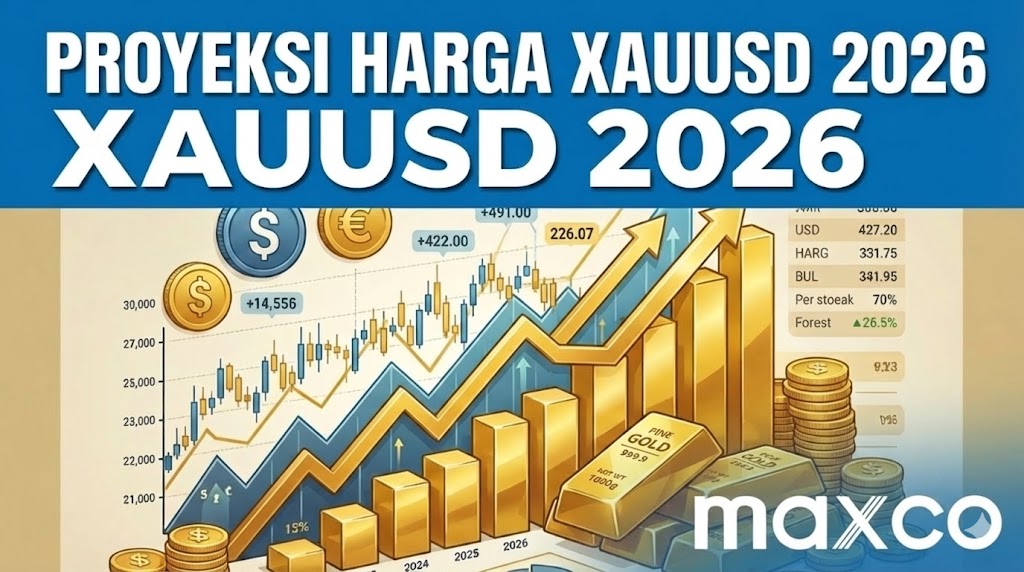
Bullish Scenario (Target: $4,500 – $5,000/toz)
This scenario occurs if:
- A global recession occurred which forced drastic interest rate cuts.
- Geopolitical escalation extends to involve nuclear powers or major trade blockades.
- The Dollar Index (DXY) fell sharply due to a loss of confidence in US Treasuries. Under these conditions, gold could breach the psychological $4,500 level and seek a new equilibrium at $5,000/oz.
Bearish Scenario (Target: $3,900 – $2,500/toz)
This scenario occurs if:
- The US economy is showing a “Super Soft Landing” where inflation is under control without a recession.
- AI technology is significantly boosting global productivity, strengthening stock markets and reducing interest in defensive assets.
- Geopolitical conflicts have significantly eased, leading to a peace agreement. Prices may correct, but the $2,300 level is likely to be a strong new floor, given the high cost of mining and central bank purchases.
XAUUSD Trading Tips for 2026
- Monitor Real Yields : In 2026, the correlation between gold and US Treasury yields will be very tight. If yields fall, gold rises. Don’t just look at inflation, but also the difference between interest rates and inflation.
- Watch Central Bank Accumulation : Data from the World Gold Council (WGC) on gold purchases by China, India, and Turkey is a valid long-term sentiment indicator.
- Beware of New York Session Volatility : The release of US labor market (NFP) and debt data will trigger extreme daily volatility. Use strict risk management.
QNA XAUUSD 2026
1. What is the general outlook for the gold market (XAUUSD) heading into 2026?
Answer: 2026 is predicted to be a “directional-setting” phase following the high volatility of 2024-2025. The market will be watching to see whether gold continues to reach its All-Time High (ATH) or experiences a correction due to economic normalization. Investors’ primary focus will be on inflation, the global debt burden, post-election monetary policy, and geopolitical dynamics.
2. How will geopolitical conflicts impact institutional gold investment in 2026?
Answer: Markets will adapt to “protracted conflicts,” particularly in the Middle East and Eastern Europe. If these conflicts permanently disrupt supply chains and energy security, institutional investors are expected to invest heavily in gold as a form of long-term diversification, not just a short-term hedge.
3. What is the role of the BRICS+ alliance in maintaining gold price stability?
Answer: In 2026, the BRICS+ dedollarization discourse is predicted to enter the implementation stage of an alternative commodity- or gold-based payment system. This will drive high demand for physical gold by central banks of member countries for trade settlements, creating significant buying power that will prevent gold prices from falling drastically.
4. Why is the debt crisis in developed countries considered a bullish signal for gold
Answer: The mounting debt in the US and other developed countries could force the Fed to loosen monetary policy (print money or lower interest rates) to prevent default. This situation reduces confidence in fiat (paper) money, making XAUUSD a primary beneficiary as a safe-haven asset.
5. What is the projected gold price for 2026 based on the economic scenario?
Answer:
- Bullish Scenario (Target $4,500 – $5,000/toz): Occurs if there is a global recession, drastic interest rate cuts, widespread geopolitical escalation, and a fall in the Dollar Index (DXY).
- Bearish Scenario (Target $3,900 – $2,500/toz): This scenario occurs if the US economy experiences a super soft landing, global productivity increases thanks to AI, and conflicts subside. However, the $2,300 level is predicted to be a strong price floor.
6. What are the key indicators recommended for gold traders to monitor in 2026?
Answer:
- Real Yields: Looks at the difference between interest rates and inflation; if yields fall, gold usually rises.
- Central Bank Accumulation: Monitoring World Gold Council (WGC) data on gold purchases by China, India, and Turkey.
- New York Session Volatility: Watch out for the release of US labor data (NFP) and debt data which trigger daily volatility.
XAUUSD 2026: A Must-Have in a Modern Portfolio
The year 2026 will be not just about price speculation, but about wealth preservation. Amid potential shifts in the global economic order and debt risks in developed countries, gold remains the “true currency.”
For traders, the volatility expected in 2026 offers tremendous two-way profit opportunities. Whether the price skyrockets to new records or undergoes a healthy correction, the XAUUSD market will always be fluid and full of opportunities.
Ready to conquer the gold market in 2026? Make sure you have the right weapons. Trade with maxco now! And for those who want to start trading gold but are confused about how to analyze it? Read the complete XAUUSD guide for beginners here!