



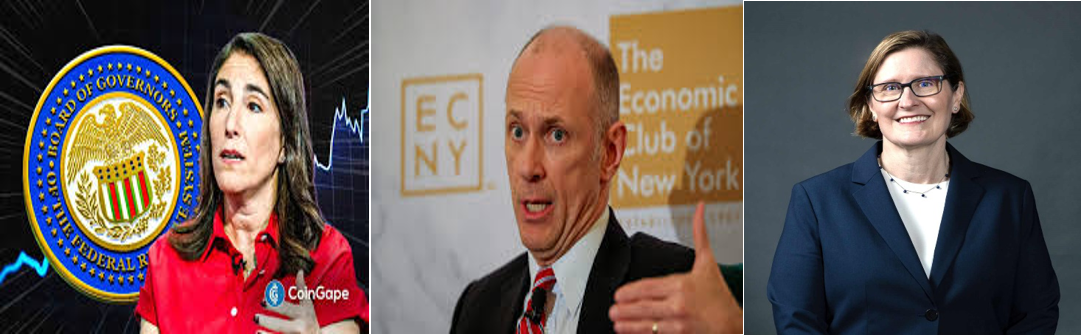
Beth Hammack
President, Federal Reserve Bank of Cleveland
Policy Stance: HAWKISH → NEUTRAL–HAWKISH
Key Insights:
- Hammack emphasizes the importance of keeping policy restrictive until inflation stabilizes convincingly.
- Her stance is consistent with the traditionally cautious approach of previous Cleveland Fed presidents toward rate cuts.
- Typical themes in Hammack’s commentary include:
- Highlighting the risk of inflation reaccelerating
- Supporting tighter policy for a longer period
- Warning that easing too quickly could trigger price volatility
Market Implications:
- The USD tends to strengthen when Hammack’s hawkish tone dominates.
- US Treasury yields often rise, putting short-term pressure on gold.
- The S&P 500 and other risk assets may come under pressure if rate-cut expectations shift toward a tighter trajectory.
Summary:
Hammack is positioned firmly in the hawkish camp and is unlikely to support rate cuts unless inflation shows a clear and convincing decline.
B. Austan Goolsbee
President, Federal Reserve Bank of Chicago
Policy Stance: NEUTRAL → MODERATELY HAWKISH
Key Insights:
- Historically, Goolsbee has leaned toward a neutral position, but recent developments show a shift toward a moderately hawkish stance.
- In the latest FOMC meeting, Goolsbee was not fully supportive of aggressive rate cuts. His recent posture reflects:
- Concerns over easing monetary policy too quickly
- A careful assessment of labor-market resilience
- A focus on long-term stability rather than reacting to short-term data fluctuations
Market Implications:
- Goolsbee’s remarks generally produce moderate yet noticeable reactions in the bond market.
- The USD tends to gain support, particularly when accompanied by strong economic data.
- Gold prices may experience mild corrections due to expectations that interest rates will remain higher for longer.
Summary:
Goolsbee remains pragmatic but leans more hawkish in the current cycle. He is likely to support policy easing only if inflation and labor-market conditions weaken substantially.
C. Anna Paulson
President, Federal Reserve Bank of Philadelphia
Policy Stance: NEUTRAL (SLIGHTLY DOVISH UNDER CERTAIN CONDITIONS)
Key Insights:
- Paulson positions herself as a balancer between the hawkish and dovish blocs.
- She is more flexible than the other two officials, adopting a strictly data-dependent approach.
- Paulson tends to show a mildly dovish inclination if:
- The disinflation trend continues
- Economic activity softens and labor-market risks rise
Market Implications:
- Paulson’s comments rarely spark large volatility, but they provide signals of stability and the possibility of easing if economic data deteriorates.
- Gold and risk assets generally react positively to her dovish tone.
- The USD may come under pressure if she hints at near-term rate-cut prospects.