



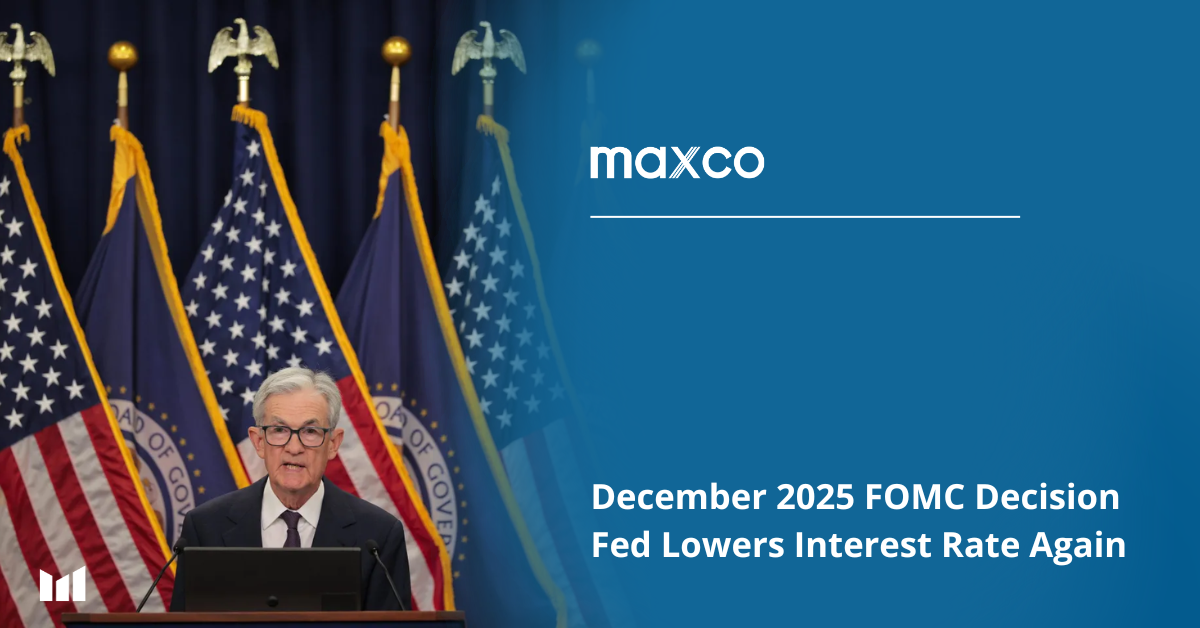
The Federal Reserve is once again at the center of global market attention after the most recent FOMC meeting, where the U.S. central bank decided to cut its benchmark interest rate. This move is part of efforts to maintain economic stability amid signs of weakening in the labor market, while still being mindful of lingering inflation risks.
The Fed officially cut the benchmark rate by 0.25 percentage points, bringing the federal funds rate to a target range of 3.50%–3.75% — the lowest level since 2022. This cut marks the third consecutive rate reduction in 2025, reflecting a more accommodative stance from the Fed in response to evolving economic conditions.
Fed Chair Jerome Powell stated that the decision was based on recent economic data indicating weakening in several key sectors.
One of the main reasons behind the Fed’s decision is the softening U.S. labor market:
- Job growth has slowed down.
- The risk of rising unemployment is becoming more apparent.
- Business activity is showing signs of moderation.
However, Powell emphasized that while the labor market is under pressure, inflation remains a primary concern. This means the rate cut is not a sign that inflation is under control, but rather an attempt to balance price stability with support for economic growth.
In its latest projections, the Fed signaled that there might be only one more rate cut in 2026. This suggests a more cautious approach, differing from expectations by some market participants who hoped for more aggressive cuts.
Powell stressed that future policy decisions will be fully data-dependent, particularly focusing on:
- inflation developments,
- labor market conditions,
- and overall economic output.
In other words, the Fed does not want to act hastily in a way that could risk price instability.
Implications of the Decision
For consumers and credit
Interest rates on consumer loans, mortgages, and business loans may decrease — though the effect may not be immediate.
For financial markets
The rate cut was met with positive reactions, as lower borrowing costs generally mean:
- cheaper loans,
- increased potential for economic growth,
- and uplift for risk assets such as equities and commodities.
For global markets
Lower U.S. interest rates may weigh on the dollar, which in turn could impact:
- global currency values,
- capital flows to emerging markets,
- and prices of global commodities like gold and oil.
The December 2025 FOMC decision marks a continuation of the Fed’s accommodative monetary stance. Although inflation has not been fully tamed, the weakening labor market has compelled the central bank to provide additional support to the economy. Nonetheless, the Fed remains cautious — making clear that future policy will heavily rely on upcoming data.
For market participants, analysts, and traders alike, this decision signals that market volatility is likely to remain high, and every subsequent U.S. economic data release will carry significant implications for the direction of global monetary policy.
Ade Yunus, ST WPA
Global Market Strategies